

Croick Church **
Region: Caithness, Sutherland & Ross
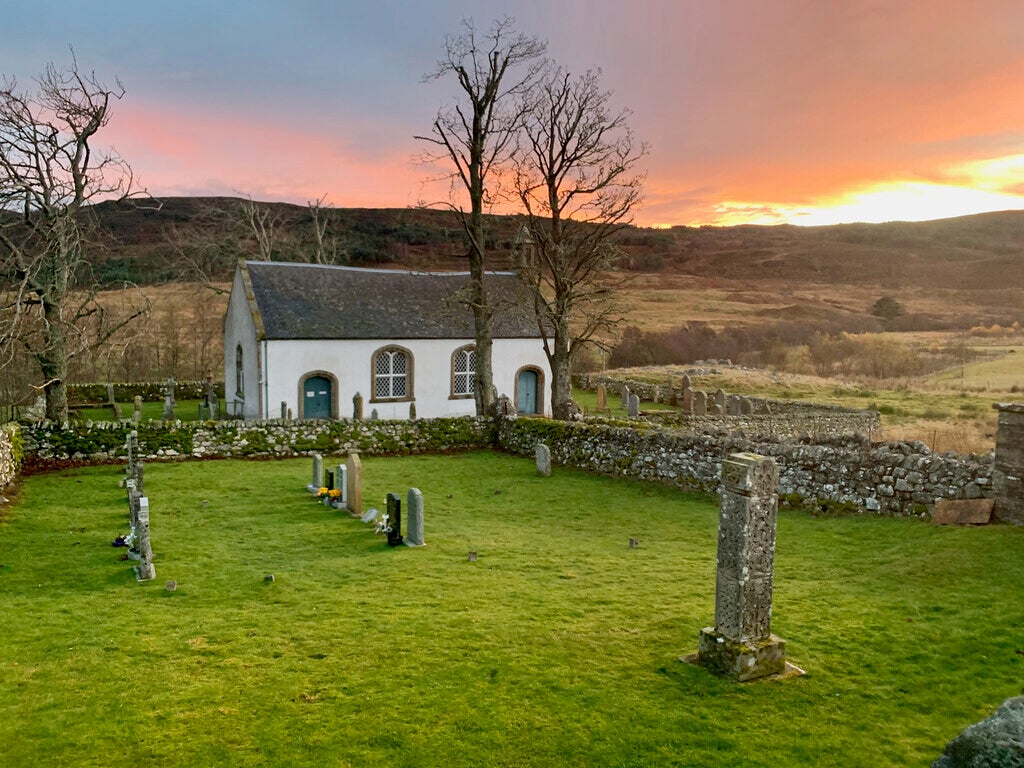
© Copyright Graeme Smith and licensed for reuse under this Creative Commons Licence.
Description:
In the very remote (at the end of a 10-mile long single track road that winds west from Bonar Bridge) and sparsely populated Highland strath of Strathcarron, the small white-harled Croick Church, despite it's diminutive appearance, conceals its status as one of Scotland's most important churches. Built in 1827 to provide places of worship for rural communities in the Scottish Highlands and islands the church seated a maximum of 200 worshippers drawn from the surrounding crofting families. Simple and unadorned, the pew-filled interior is focussed on the dominant pulpit. The long communion table, running the full width of the church, is a rare survival and one of the few remaining in Scotland today.
Following the Disruption of 1843 (when 450 ministers broke away from the Church of Scotland to form the Free Church of Scotland), most local families followed their minister, the Rev Gustavus Aird, and joined the Free Church. This may explain why, on 24th May 1845, tenant families evicted forcibly from their homes to make way for a sheep farm, sheltered in the graveyard rather than the church. 80 people including children, the elderly, and sick, set up a make-shift camp behind the church.
A reporter from The Times witnessed their plight and his moving account helped turn the tide of public opinion against the dispossession of tenants by wealthy landowners: "It was a most wretched spectacle to see these poor people march out of the glen in a body, with two or three carts filled with children, many of them mere infants. A fire was kindled in the churchyard, around which the poor children clustered. Two cradles, with infants in them, were placed close to the fire and sheltered round by the dejected looking mothers."
A tangible reminder of this bleak episode can be seen in the messages scratched on the outside of the east window of the church, including the names of some of the displaced people. It is not known if these were made at the time by those sheltering in the graveyard, or perhaps later by others wanting to ensure the Glencalvie people were never forgotten.
Closed by the Church of Scotland in 2020, Croick Church is now open throughout the year to visitors. Occasional services are held in the summer months together with weddings and funerals.